Insights from Vaidya Balendu Prakash on Disease Progression and Longevity
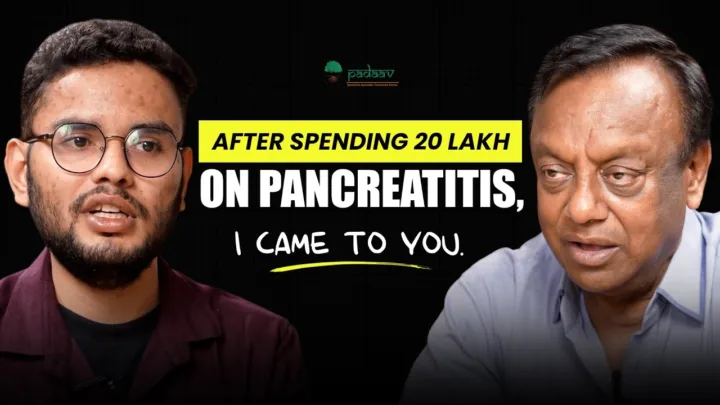
In a direct and important discussion with a mother, Sarika, regarding her son’s Pancreatitis after gallbladder removal, Vaidya Balendu Prakash clarifies the critical link between the two organs and stresses that lifestyle correction is the only path to survival from this progressive disease.
Part 1: The Gallbladder, Pancreatitis, and the “Not-an-Answer” Surgery
A key question was raised: Sarika’s son had his gallbladder removed in 2024 due to stones, two years after the problem began. Given the link between the gallbladder and the pancreas, what greater precautions are needed now?
The Vicious Cycle:
Vaidya Prakash explained that removing the gallbladder is often “not the answer” because the underlying cause remains.
-
-
The Link: The two organs share a common duct. When the gallbladder malfunctions (often due to poor diet/timing), it stresses the pancreas, leading to inflammation (Pancreatitis).
-
-
The Prognosis: He noted that post-gallbladder removal, many patients still face recurring attacks, which indicates the disease has progressed and the cause was rooted deeper than the stone itself.
Part 2: The Grim Truth of Progression and the Need for Discipline
Vaidya Prakash delivered a stark reality check on the progressive nature of Pancreatitis, emphasizing that without strict adherence to the prescribed lifestyle, the outcome is poor:
“This is not a disease; we are treating death.”
-
Longevity Data: Based on his clinical experience:
-
In India: 92% of patients die within 10 years.
-
In the US: 55% of patients die within 20 years.
-
The Non-Negotiable Rules for Survival:
He stressed that the disease is primarily a “game of diet and lifestyle” (Khanpan Jeevan Shaili Ka Khel).
-
Strict Sleep Schedule: The patient must go to sleep by 9:30-10:00 PM and wake up by 6:00 AM.
-
Parental Control (The ‘Maa’ Principle): He directly admonished the mother for becoming a ‘Mada’ (one who gives birth) instead of a ‘Maa’ (one who knows the quantity and rules of life). He stated that allowing a child to dictate the diet (like demanding kulchas instead of a healthy breakfast) and sleep schedule is the root cause of the disease.
-
No Exceptions: If the life discipline established at Padaav is followed, the progression of the disease will stop. If the indiscipline returns, the disease will return.
Part 3: Future Outlook and Final Guidance
1. Marriage and Physical Activity
-
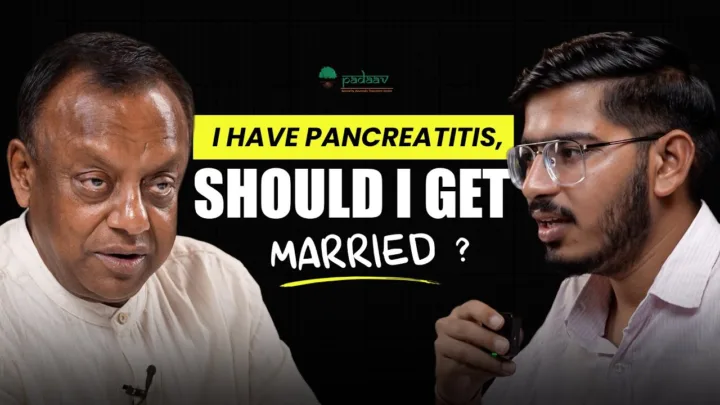
Marriage: Vaidya Prakash confirmed that marriage is absolutely possible, provided the patient follows the regimen and achieves stability. He humorously advised the patient to maintain discipline to avoid giving the disease a chance to relapse.
-
Work/Exercise: He clarified that while light physical activity and factory work (non-lifting roles) are fine, the patient must avoid heavy lifting or high-impact exercises like gymming for now. Simple walking is recommended. The focus must be on mental and physical rest initially.
2. Overweight and Weight Loss
He noted that the patient was previously overweight (100 kg), which is a known cause of Pancreatitis.
-
The recent weight loss, while significant, might bring the patient closer to a healthier BMI (Body Mass Index). Patients were advised to calculate their BMI and strive to maintain a healthy range, as obesity places undue stress on the pancreas and liver.
3. Disease Stability
The crucial difference between the stages of Pancreatitis was clarified:
-
Acute: Can reverse completely.
-
Chronic (with Changes): The structural damage (calcification) cannot be reversed but will stop progressing if the regimen is strictly followed. The goal is to halt the damage exactly where it is now.
The final message echoed the Ayurvedic wisdom: “Jab Jago Tab Savera” (When you wake up, that’s morning). It is never too late to adopt the discipline necessary to stop the disease.