In a world where diet fads come and go, the timeless principles of Ayurveda stand as a profound and unwavering guide to well-being. At Padaav Ayurveda, we believe these ancient texts are not just doctrines they are a source of constant wonder and a testament to the meticulous, investigative minds of our ancient sages. These principles were not born in a day but from centuries of careful observation, analysis, and a deep understanding of the human body, and are meticulously practiced and preserved by our expert team led by Vaidya Shikha Prakash and Padma Shree Vaidya Balendu Prakash.
Central to this wisdom are two powerful concepts: Ahar Aushadh (food as medicine) and Pragyaparadha (the offense against wisdom).
The Power of Ahar Aushadh: Food as Medicine
Ayurveda explains that a balanced diet is far more than just eating a single food item. A meal consisting of just poha, a bowl of fruit, or a glass of milk is fundamentally imbalanced because it lacks the necessary combination of nutrients. The secret to a wholesome meal is the synergy of its components.
Every culture, from East to West, has intuitively created its own version of a balanced meal:
- In Western Uttar Pradesh, it’s roti and dal (carbohydrate & protein).
- In coastal regions, it’s rice and fish (starch & protein).
- In Europe, it’s often potatoes and fish (starch & protein).
- Even a “full English breakfast” combines dairy, cereals, fruits, and meat or eggs to ensure a balance of vitamins, minerals, carbohydrates, and protein.
This principle of Ahar Aushadh is about using food as medicine, both to prevent and to heal. It also speaks to the importance of how food is prepared. For instance, moong dal can be difficult to digest for some, but when soaked, ground, and fried as part of dahi vada, it becomes easily digestible and therapeutic. The key is mindful preparation and consumption to honor our digestive system.
Understanding the Six Principles of a Healthy Diet
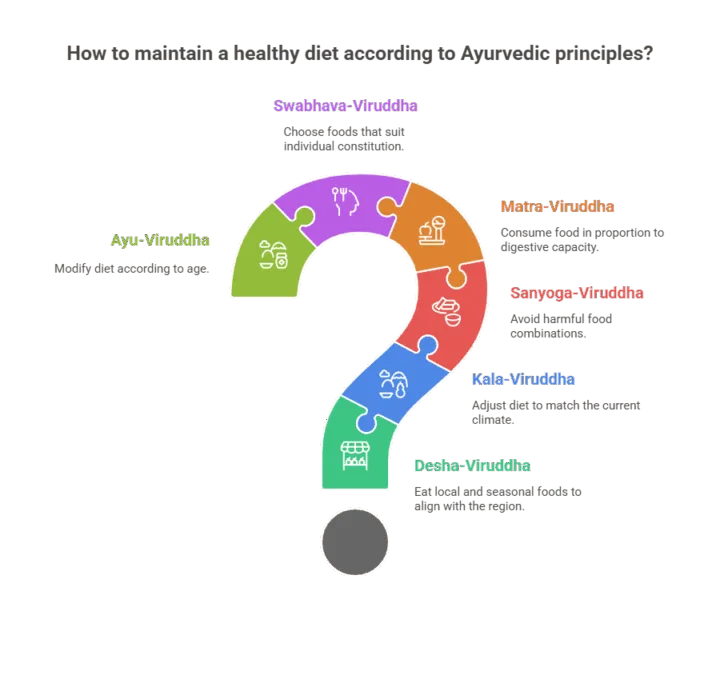
Ayurveda provides a detailed framework for a healthy diet, outlining six key factors that, when ignored, become causes of disease. These are:
- Desha-Viruddha (Opposite to the Region): Food should be local and seasonal. Eating mangoes from South India in a region like North India where they are not currently in season is an example of Desha-Viruddha.
- Kala-Viruddha (Opposite to the Season): The food we eat should align with the current climate. A food that is fine to eat in the summer may be ill-suited for the winter.
- Sanyoga-Viruddha (Incompatible Combinations): Certain food pairings can be harmful. For instance, combining milk with curd or radish can create an incompatible combination.
- Matra-Viruddha (Improper Quantity): The quantity of food must be in proportion to our digestive capacity, or jathragni. Eating too much, even of a healthy food, is a form of dietary transgression.
- Swabhava-Viruddha (Opposite to Individual Nature): Some foods, though considered universally good, may not suit an individual’s unique constitution. For some, even amla (Indian gooseberry) can cause problems.
- Ayu-Viruddha (Opposite to Age): Our diet must change with our age. The rich ghee and butter consumed in childhood are not appropriate for old age.
Pragyaparadha: The Offense Against Wisdom
While diet is critical, Ayurveda posits that a major cause of disease is Pragyaparadha, which translates to “offense against wisdom.” This is the conscious act of doing something we know is bad for us. It’s a concept that transcends physical food and extends to our entire lifestyle, or Vihar.
The symptoms of this “offense” are everywhere:
- We know a seatbelt saves lives, but we often don’t wear it.
- We know smoking is harmful, but we continue to do it, sometimes out of addiction (vyasan).
- We know the importance of rest, but we eat meals during stressful meetings or stay up late, forcing our bodies to work against their natural rhythms.
In essence, we have lost the self-control and moderation required to honor our bodies.
The body is a temple. It’s a temple of diseases, but it’s also our temple. We spend our lives worshipping gods we cannot see, but we often neglect the one temple that is always with us. True well-being begins with a commitment to our body its needs, its rhythms, and its wisdom so that we may live a life of complete health and vitality.